


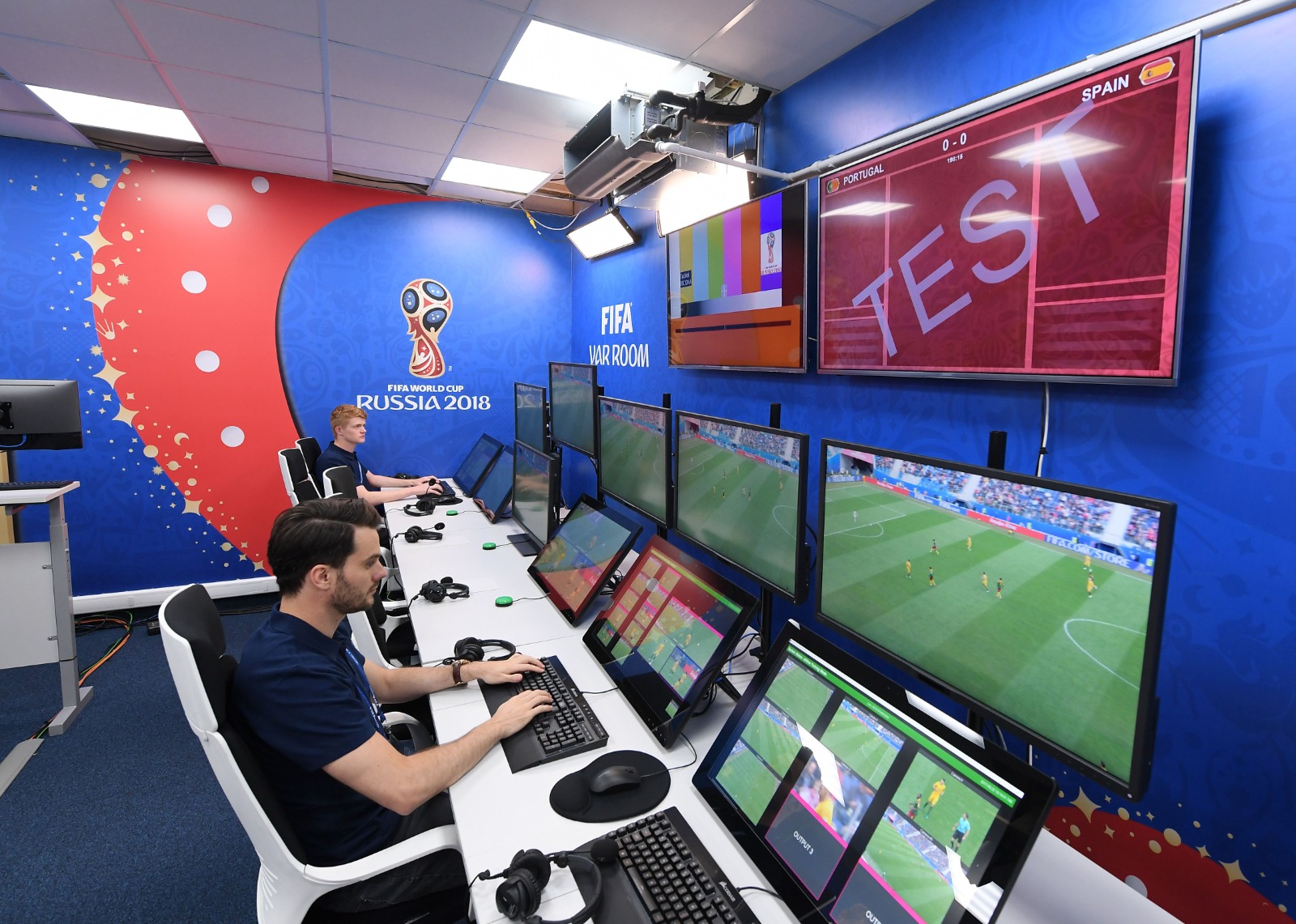
For generations, football has been defined by the authority of the referee’s whistle, decisive, immediate, and human. But on a tense Champions League night between Atletico Madrid and Arsenal, that long-standing tradition once again found itself overshadowed, not by the players, but by a screen.
The controversial VAR intervention in the semi-final first leg has reignited a debate that refuses to go away. Is technology enhancing the game, or quietly taking control away from those meant to govern it?

In theory, the video assistant referee system was introduced to eliminate clear and obvious errors. In practice, it is increasingly becoming the central decision-maker, reducing on-field referees to intermediaries between the pitch and a remote control room. The moment in question lengthy, scrutinized from multiple angles, and ultimately decisive left players, coaches, and fans in limbo. Not because the decision was necessarily wrong, but because it no longer felt owned by the referee.
Football thrives on rhythm, emotion, and spontaneity. A referee’s decision, even when debated, carries a sense of immediacy that keeps the game alive. VAR, however, interrupts that flow. The game pauses, tension builds unnaturally, and when the decision finally arrives, it often feels detached from the moment itself. The referee, once the unquestioned authority, now gestures toward an invisible arbiter.
When a referee makes a call, right or wrong, they stand by it. Their positioning, interpretation, and courage are part of the game’s fabric. But when VAR intervenes, responsibility becomes blurred. Is it the referee’s decision, or the VAR official’s? Who truly controls the match? In high-stakes encounters like Atletico versus Arsenal, that ambiguity becomes more than philosophical it becomes consequential.

Moreover, the growing reliance on VAR risks over-policing the game. Football is not a sport designed for forensic analysis frame by frame. Contact, intent, and context often exist in grey areas that technology struggles to interpret cleanly. By attempting to eliminate all controversy, VAR may be stripping away the very debates and imperfections that make football compelling.
None of this is to argue that technology has no place in modern football. Goal-line technology, for instance, has been widely accepted because of its speed and clarity. VAR, however, operates in a far more subjective space, where interpretation not just accuracy is key. And that is where its influence becomes problematic.
The Atletico-Arsenal incident is not an isolated case. It is part of a growing pattern where matches are increasingly shaped by prolonged reviews rather than instinctive officiating. The danger is not just that VAR gets involved, it is that it gets involved too often, too deeply, and with too much authority.
If football is not careful, it risks losing something fundamental: the human element of decision-making that has defined the sport for over a century.
The whistle still blows, but more and more, it feels like an echo.
BY: ADDY KENNEDY EDEM